



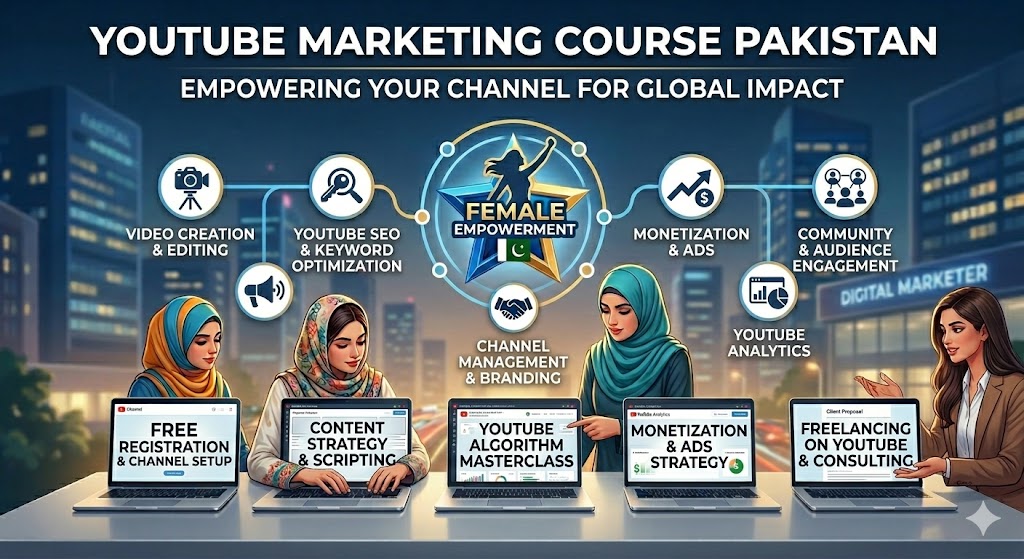
YouTube Marketing Course Pakistan
Introduction
A few years ago, becoming “famous” required television access, production studios, or serious industry connections. Today, a student with a smartphone in Lahore, Karachi, or Islamabad can build a YouTube channel that reaches millions. Some turn it into a side income. Others build full-time careers around it.
But here’s the truth most beginners learn the hard way: uploading videos is easy. Growing a channel is not.
That’s where a structured YouTube marketing course in Pakistan becomes valuable. It’s not just about editing videos or getting views. It’s about understanding how YouTube works as a search engine, how the algorithm recommends content, how to build an audience strategically, and how to monetize ethically and sustainably.
In this guide, I’ll walk you through what a YouTube marketing course really includes, why it matters for students, what skills you should expect to learn, common myths beginners believe, and how YouTube marketing fits into the broader digital marketing ecosystem. By the end, you’ll understand whether this path is right for you and how to start smart.
What YouTube Marketing Really Means (Beyond Just Uploading Videos)
Many beginners think YouTube marketing simply means “making videos and hoping they go viral.” That’s not marketing that’s gambling.
YouTube marketing is the strategic use of video content to:
-
Build an audience
-
Increase brand awareness
-
Generate leads or sales
-
Earn revenue through ads and partnerships
-
Establish authority in a niche
YouTube is not just a social media platform. It’s the second-largest search engine in the world after Google. People don’t just scroll they search.
Think about how students use it:
-
“How to prepare for CSS exams”
-
“Best freelancing skills in Pakistan”
-
“Learn Python for beginners”
-
“IELTS speaking tips”
Every one of these searches is an opportunity.
A professional YouTube marketing course teaches you how to:
-
Identify searchable topics
-
Create content people actually want
-
Optimize videos for discovery
-
Understand watch time and audience retention
-
Convert viewers into subscribers or customers
In other words, it teaches you to build a system not chase luck.
How YouTube’s Algorithm Works (In Simple Terms)
The YouTube algorithm isn’t a mysterious monster. It’s actually quite logical.
Its job is simple: keep people watching for as long as possible.
To do that, YouTube analyzes:
-
Click-through rate (CTR)
-
Watch time
-
Audience retention
-
Engagement (likes, comments, shares)
-
Viewer satisfaction signals
The Two Main Discovery Paths
1. Search-Based Discovery
When someone types a query, YouTube shows videos based on:
-
Relevance (keywords in title, description, tags)
-
Watch performance
-
Authority of the channel
2. Recommendation-Based Discovery
This includes:
-
Home page suggestions
-
Suggested videos
-
“Up next” recommendations
Here, YouTube focuses heavily on:
-
Viewer behavior patterns
-
Similar audience interests
-
Session watch time
A strong YouTube marketing course in Pakistan should teach both search optimization and recommendation strategy because relying on one alone limits growth.
Core Components of YouTube Marketing
Let’s break this down into practical, learnable skills.
1. Content Strategy and Niche Selection
Most beginners fail because they start without clarity.
They upload:
-
One cooking video
-
One tech review
-
One motivational talk
-
One travel vlog
There’s no positioning.
A good course teaches you:
-
How to choose a profitable niche
-
How to validate demand
-
How to analyze competitors
-
How to create a content roadmap
For example, instead of “Education Channel,” you might focus on:
-
“Entry Test Preparation for Pakistani Students”
-
“Freelancing Skills for Beginners in Pakistan”
-
“Amazon FBA for Local Sellers”
Clarity builds authority.
2. YouTube SEO (Search Optimization)
Yes, YouTube SEO is real and it’s powerful.
It includes:
-
Keyword research for video topics
-
Optimized titles
-
Compelling thumbnails
-
Strategic descriptions
-
Proper tagging
-
Playlist optimization
For instance:
Instead of:
“Digital Marketing Tips”
You might create:
“Digital Marketing Skills Every Pakistani Student Must Learn in 2026”
Specific. Targeted. Searchable.
A quality YouTube marketing course should teach you how to think like both a creator and a search strategist.
3. Thumbnail and Click Psychology
YouTube is competitive.
Your video competes with:
-
Other creators
-
Shorts
-
Netflix
-
Instagram Reels
Your thumbnail and title determine whether someone clicks.
Students should learn:
-
Color contrast
-
Emotional triggers
-
Curiosity gaps
-
Text hierarchy
-
Avoiding clickbait
Clickbait gets clicks.
Value builds channels.
A course should teach the difference.
4. Audience Retention and Watch Time
This is where many creators struggle.
You might get clicks — but if people leave after 20 seconds, YouTube stops recommending your content.
Retention improves when you:
-
Hook viewers in the first 10 seconds
-
Avoid long intros
-
Deliver value quickly
-
Use storytelling
-
Structure content clearly
-
Edit tightly
A well-designed course teaches scripting frameworks and video flow strategies not just technical editing.
5. Monetization and Revenue Models
Many students enroll because they want income opportunities.
YouTube offers multiple monetization paths:
-
AdSense revenue
-
Brand sponsorships
-
Affiliate marketing
-
Selling digital products
-
Freelance services
-
Online courses
-
Consulting
For example:
A student teaching Excel tutorials might:
-
Earn from ads
-
Offer paid Excel templates
-
Provide corporate training services
The real opportunity is diversification — not depending only on ads.
How YouTube Marketing Fits into Digital Marketing
YouTube doesn’t operate in isolation.
It connects with:
-
SEO (Google ranking)
-
Social media marketing
-
Email marketing
-
Personal branding
-
Affiliate marketing
-
E-commerce
For example:
A local clothing brand in Pakistan could:
-
Use YouTube for styling tutorials
-
Drive traffic to Instagram
-
Capture emails via free style guides
-
Sell directly through Shopify
This ecosystem approach multiplies impact.
A strong YouTube marketing course should explain how video fits into the bigger digital marketing picture — not treat it as a standalone skill.
Real-World Example: From Student to Creator
Let’s consider a realistic scenario.
A university student in Abbottabad starts a channel focused on “Freelancing for Beginners in Pakistan.”
Month 1:
-
Learns keyword research
-
Publishes 8 targeted videos
Month 3:
-
Videos rank for specific queries
-
Gains 3,000 subscribers
Month 6:
-
Launches a beginner freelancing course
-
Secures first sponsorship
This growth isn’t magic.
It’s strategy.
And that strategy is exactly what structured learning provides.
Common Myths About YouTube Marketing
Myth 1: You Need Expensive Equipment
Not true.
Good lighting and clear audio matter more than a luxury camera.
Many successful creators started with smartphones.
Myth 2: You Must Show Your Face
Not necessarily.
Educational channels, animation channels, screen-record tutorials many succeed without face exposure.
Myth 3: You Need to Go Viral
Sustainable growth is better than viral spikes.
Ten consistent videos with 5,000 views each are more powerful than one viral video followed by silence.
Myth 4: It’s Too Late to Start
YouTube is growing every year.
New niches emerge constantly.
What’s saturated is low-quality content not quality education or value-driven videos.
Practical Skills Students Should Start Learning Today
If you’re serious about enrolling in a YouTube marketing course in Pakistan, start building these skills now:
-
Basic video editing
-
Keyword research fundamentals
-
Script writing
-
Public speaking or voice clarity
-
Thumbnail design basics
-
Analytics interpretation
Even before joining a course, start observing:
-
Why did this video get 1M views?
-
Why is this thumbnail effective?
-
Why does this channel grow faster?
Observation sharpens strategy.
Career Opportunities in YouTube Marketing
The opportunity isn’t limited to becoming a YouTuber.
You can work as:
-
YouTube SEO specialist
-
Thumbnail designer
-
Video editor
-
Channel manager
-
Scriptwriter
-
Content strategist
-
Analytics consultant
Many Pakistani freelancers now offer YouTube optimization services internationally.
Companies also hire in-house video marketing teams.
The demand for video content is increasing not decreasing.
What to Look for in a YouTube Marketing Course in Pakistan
Before enrolling, check:
-
Does it cover YouTube SEO?
-
Does it teach analytics?
-
Are real case studies included?
-
Does it explain monetization models?
-
Is there practical project work?
-
Are instructors active creators or marketers?
Avoid courses that promise:
-
Guaranteed monetization in 30 days
-
Instant viral growth
-
“Secret hacks”
There are no hacks.
Only strategy and consistency.
FAQs About YouTube Marketing Course Pakistan
Is YouTube marketing a good career in Pakistan?
Yes. With rising internet usage and global freelancing access, YouTube marketing offers both local and international opportunities.
How long does it take to grow a YouTube channel?
Most channels take 6–12 months of consistent effort to see meaningful traction. Growth depends on niche, strategy, and content quality.
Do I need technical skills before joining?
No. Beginner-friendly courses start from basics like niche selection, scripting, and simple editing.
Can students earn while studying?
Yes. Many students monetize through affiliate marketing, sponsorships, or freelancing services before full monetization eligibility.
Is YouTube marketing better than freelancing?
It depends on your goals. YouTube builds long-term brand equity, while freelancing offers faster short-term income. Many combine both.
Conclusion
YouTube is no longer just an entertainment platform. It’s an education hub, a business engine, and a career pathway especially for students willing to learn strategically.
A well-structured YouTube marketing course in Pakistan can help you avoid beginner mistakes, understand the algorithm, build an audience with intention, and create sustainable income streams. But remember: no course replaces effort.
The real advantage comes when you combine:
-
Strategic knowledge
-
Consistency
-
Patience
-
Continuous learning
Video content will only grow in importance over the next decade. The students who understand how to use it intelligently won’t just consume content they’ll shape it.
And that shift, from viewer to creator, is where opportunity begins.
Tags :
No Tags

0 Comments