



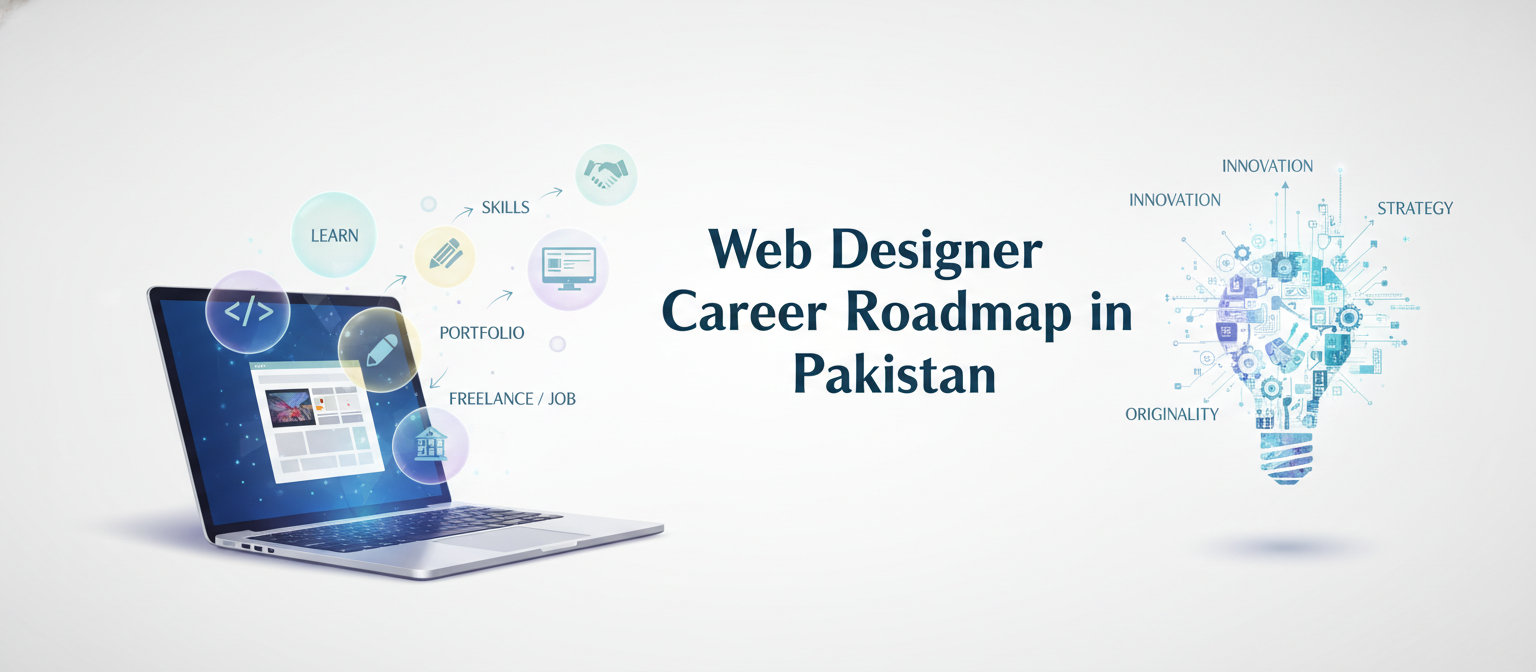
Web Designer Career Roadmap in Pakistan
Introduction
A few years ago, becoming a web designer in Pakistan often meant learning basic HTML, creating simple layouts, and hoping to land a freelance project on Facebook or Fiverr. Today, the landscape looks very different. Businesses—from small local shops in Abbottabad to growing eCommerce brands in Karachi understand that their website is their digital storefront. And that has dramatically increased the demand for skilled web designers.
If you’re a student wondering whether web design is a “real” career, or a beginner confused about where to start, you’re not alone. The field can feel overwhelming: HTML, CSS, WordPress, UX, UI, freelancing, internships, agencies—where do you even begin?
In this roadmap, I’ll walk you step-by-step through how to build a successful web design career in Pakistan. You’ll learn what skills to develop, what tools to master, where the real opportunities are, and how to grow from beginner to professional whether your goal is a job, freelancing, or starting your own agency.
Let’s break it down clearly and practically.
Understanding the Web Design Industry in Pakistan
Before planning your career, it’s important to understand the market you’re entering.
Pakistan’s digital economy is expanding rapidly. Thousands of small and medium businesses are moving online. Startups are launching eCommerce stores. Educational institutions need websites. NGOs, real estate companies, clinics, restaurants—almost every industry requires a web presence.
This creates three main types of opportunities:
-
Agency jobs (software houses and digital marketing agencies)
-
Freelancing platforms (Upwork, Fiverr, Freelancer)
-
Remote international work (working with clients abroad)
-
Entrepreneurship (starting your own design agency)
The demand is real but competition is increasing. That means skills, professionalism, and portfolio matter more than ever.
Step 1: Build a Strong Foundation (The Beginner Phase)
Every professional web designer starts with the basics.
Learn the Core Technologies
You cannot skip fundamentals. Even if you plan to use WordPress or website builders, understanding the core structure of websites gives you an edge.
Start with:
-
HTML – Structure of a website
-
CSS – Design, colors, layout, responsiveness
-
Basic JavaScript – Interactive elements
Don’t rush this stage. Many beginners jump straight into advanced tools without understanding how websites actually work.
Understand Responsive Design
In Pakistan, most users browse on mobile devices. If you design websites that only look good on a laptop, you’ll struggle professionally.
Learn:
-
Mobile-first design
-
Media queries
-
Flexible layouts
-
Testing on different screen sizes
Beginner Takeaway
Spend your first 3–6 months mastering fundamentals. Practice by building simple websites:
-
Personal portfolio
-
Restaurant website mockup
-
Educational institute homepage
-
E-commerce landing page
Practice matters more than certificates.
Step 2: Move Into Modern Web Design Tools
Once your basics are strong, it’s time to learn industry tools.
UI/UX Design Principles
Web design isn’t just about colors and fonts. It’s about solving problems.
Understand:
-
User experience (UX)
-
User interface (UI)
-
Navigation flow
-
Readability and hierarchy
-
Conversion-focused design
Ask yourself:
Does this website make it easy for users to take action?
Learn Design Tools
Popular tools include:
-
Figma (highly recommended)
-
Adobe XD
-
Canva (basic use)
-
Photoshop (for graphics)
Figma is particularly powerful and widely used in agencies and startups.
WordPress and CMS Platforms
In Pakistan, a large percentage of client websites are built on WordPress.
Learn:
-
WordPress installation
-
Themes and customization
-
Elementor or other page builders
-
Basic plugins
-
Speed optimization basics
Knowing WordPress dramatically increases your job and freelance opportunities.
Step 3: Build a Professional Portfolio
In web design, your portfolio is your degree.
Clients and employers care less about your certificate and more about your work.
What Should Your Portfolio Include?
-
4–6 high-quality projects
-
Before-and-after redesign examples
-
Live demo links
-
Clear explanation of your design decisions
-
Mobile and desktop screenshots
If you don’t have real clients yet, create sample projects. Redesign local business websites as practice. Approach small businesses and offer free or discounted work in exchange for testimonials.
Important: Quality Over Quantity
Five excellent projects are better than 20 average ones.
Step 4: Choose Your Career Path
After 1–2 years of learning and practice, you’ll likely face a decision.
Option 1: Job in a Software House
Pros:
-
Stable income
-
Team learning
-
Real-world experience
-
Structured growth
Cons:
-
Lower starting salary
-
Fixed hours
In cities like Islamabad, Lahore, and Karachi, junior web designers typically start with entry-level salaries. Growth depends heavily on skill level and communication ability.
Option 2: Freelancing
Pakistan is one of the top freelancing countries in the world.
Pros:
-
Unlimited income potential
-
Flexible hours
-
International clients
Cons:
-
Inconsistent income at the beginning
-
Requires strong communication
-
Requires self-discipline
If you choose freelancing, focus on:
-
Clear proposals
-
Strong portfolio
-
Professional communication
-
Client relationship management
Option 3: Hybrid Approach
Many designers work a full-time job and freelance part-time. This is often the smartest and safest route in the early years.
Step 5: Develop Business and Soft Skills
Here’s something most beginners ignore:
Technical skills alone are not enough.
You must develop:
-
Communication skills
-
Proposal writing
-
Client handling
-
Time management
-
Basic pricing strategy
In Pakistan’s freelance market, designers who communicate clearly in English often earn significantly more than technically stronger designers with poor communication skills.
Learn how to:
-
Explain your design decisions
-
Handle revisions professionally
-
Set boundaries with clients
-
Deliver on time
These skills directly impact income.
Step 6: Specialize to Increase Income
General web designers are common. Specialists earn more.
After gaining experience, consider specializing in:
-
eCommerce design (Shopify, WooCommerce)
-
Landing page optimization
-
UI/UX design for startups
-
Conversion rate optimization
-
Website speed optimization
-
Web accessibility
Specialization helps you:
-
Charge premium rates
-
Target higher-value clients
-
Build authority
Real-World Example
Let’s consider a typical journey:
A student from Abbottabad learns HTML and CSS during college. He builds practice projects for six months. Then he learns WordPress and Figma. After creating a portfolio website, he applies for internships at software houses.
Within a year, he gets a junior designer role. He works there for two years, building real client projects. Meanwhile, he starts freelancing on Fiverr. His first few orders are small, but over time he builds reviews.
After three to four years, he either:
-
Becomes a senior designer in an agency
-
Goes full-time freelance
-
Starts his own small design agency
This progression is realistic and achievable with consistency.
Common Mistakes Beginners Make
1. Chasing Too Many Skills at Once
Trying to learn graphic design, video editing, SEO, coding, and digital marketing all together slows progress.
Focus first. Master web design before expanding.
2. Ignoring Fundamentals
Using drag-and-drop builders without understanding HTML and CSS limits long-term growth.
3. Copying Designs Blindly
Inspiration is good. Blind copying without understanding layout structure is not.
4. Underpricing Forever
Low prices help you start but staying cheap keeps you stuck.
5. Not Building Personal Brand
LinkedIn presence, portfolio website, and consistent online activity matter.
How the Web Design Career Is Evolving
The industry is changing.
AI Tools and Automation
Design tools are becoming smarter, but they do not replace creative thinking or user experience understanding.
Demand for UX Specialists
Businesses want websites that convert visitors into customers not just attractive layouts.
Remote Work Opportunities
Pakistani designers now work for companies in the US, UK, UAE, and Australia remotely.
Integration with Digital Marketing
Web designers who understand SEO, conversion optimization, and digital marketing strategy have a major advantage.
The future belongs to designers who combine creativity with strategic thinking.
Practical Skills You Should Start Learning Today
If you’re serious about this career, start focusing on:
-
HTML & CSS mastery
-
Responsive design
-
Figma proficiency
-
WordPress customization
-
Basic SEO understanding
-
Website speed fundamentals
-
UX principles
-
Client communication
Set a 12-month roadmap instead of expecting success in 30 days.
Frequently Asked Questions (FAQs)
1. Is web design a good career in Pakistan?
Yes. With increasing digital adoption and global freelancing opportunities, web design offers strong income potential and remote work flexibility.
2. Do I need a degree to become a web designer?
No. A strong portfolio and practical skills matter more than a formal degree. However, a related degree can help with job opportunities.
3. How long does it take to become job-ready?
With consistent effort, 6–12 months is realistic for entry-level skills. Mastery takes years of practice.
4. Can I earn in dollars as a web designer from Pakistan?
Yes. Many Pakistani designers work with international clients through freelancing platforms and remote jobs.
5. What is the starting salary of a web designer in Pakistan?
Entry-level salaries vary by city and skill level, but experienced designers can significantly increase their income through specialization and freelancing.
Conclusion
A web design career in Pakistan is not a shortcut to instant money but it is a powerful, realistic, and scalable opportunity.
The key is structured growth. Start with strong fundamentals. Build real projects. Create a professional portfolio. Develop communication skills. Choose your path wisely job, freelance, or hybrid. Then specialize and refine your expertise.
The digital economy in Pakistan is expanding. Businesses need skilled designers who understand both design and strategy. If you commit to learning deeply instead of rushing results, you can build not just a job but a long-term, location-independent career.
Your journey won’t be perfect. But if you stay consistent, keep improving, and treat your skills like a professional asset, web design can open doors you never imagined.
Start today. Build one project. Then another. That’s how real careers are made.
Tags :
No Tags
0 Comments