



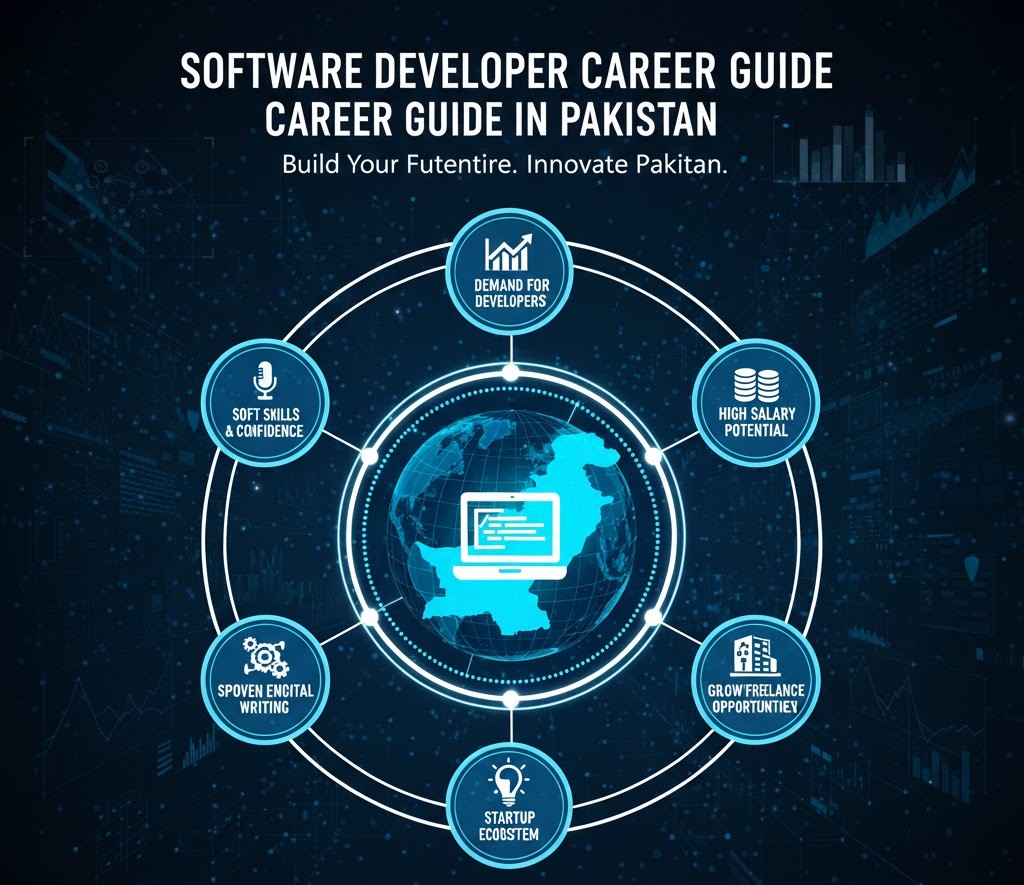
reputation as a Software Developer Career Guide in Pakistan
Introduction
A few years ago, becoming a doctor or engineer was seen as the safest path to success in Pakistan. Today, there’s another career quietly reshaping the future: software development. From startups in Lahore and Karachi to remote teams working with clients in the US and Europe, Pakistani software developers are building apps, websites, fintech platforms, e-commerce systems, and even AI-powered tools used around the world.
If you’re a student wondering whether software development is the right path for you, you’re not alone. The demand for skilled developers has never been higher. Companies are digitizing operations. Businesses are moving online. Global clients are outsourcing projects. And remote work has removed geographical barriers.
This guide will walk you through everything you need to know about becoming a software developer in Pakistan. We’ll explore what software developers actually do, the skills you need, education options, salary expectations, freelancing opportunities, career paths, and how to future-proof your skills in a rapidly evolving industry.
By the end, you’ll have a clear, realistic roadmap not just motivation, but direction.
What Does a Software Developer Really Do?
When people hear “software developer,” they often imagine someone typing fast in a dark room full of code. In reality, the job is far more dynamic and collaborative.
At its core, a software developer solves problems using technology. That could mean:
-
Building a mobile app for a food delivery service
-
Creating a website for a clothing brand
-
Developing accounting software for businesses
-
Designing backend systems for a fintech startup
-
Automating processes inside a company
Developers don’t just write code. They:
-
Understand user requirements
-
Plan system architecture
-
Test and debug applications
-
Collaborate with designers and product managers
-
Maintain and improve existing systems
In short, they turn ideas into functional digital products.
Why Software Development Is Growing Fast in Pakistan
Pakistan’s IT industry has experienced strong growth over the last decade. Government initiatives, IT exports, freelancing platforms, and startup culture have all contributed to this expansion.
Here’s why software development is especially promising in Pakistan:
1. Global Freelancing Hub
Pakistan consistently ranks among the top countries on platforms like Upwork and Fiverr. Many developers work remotely for international clients and earn in dollars.
2. Expanding Startup Ecosystem
Cities like Lahore, Karachi, and Islamabad have growing tech startups in fintech, edtech, healthtech, and e-commerce. These companies constantly need skilled developers.
3. IT Export Growth
Pakistan’s IT exports continue to increase year after year, creating more demand for skilled professionals.
4. Remote Work Opportunities
Unlike many professions, software development doesn’t require relocation. You can work from Abbottabad, Peshawar, or Multan and still serve global clients.
For students, this means opportunity is no longer limited by geography.
Education Pathways: Degree vs. Self-Taught
One of the biggest questions students ask is: Do I need a degree to become a software developer?
The honest answer: A degree helps, but it’s not the only path.
Option 1: University Degree
Common degrees include:
-
BS Computer Science
-
BS Software Engineering
-
BS Information Technology
A formal degree provides:
-
Strong theoretical foundations
-
Structured learning
-
Internship opportunities
-
Networking with professors and peers
Top universities in Pakistan offer reputable CS programs, but admission can be competitive.
Option 2: Self-Taught + Online Learning
Many successful developers in Pakistan are self-taught. They learn through:
-
Online courses
-
YouTube tutorials
-
Coding bootcamps
-
Practice projects
What matters most in software development is not your degree it’s your skills and portfolio.
Practical Advice for Students
If you can pursue a CS degree, it’s a solid foundation. But regardless of your education path:
-
Start coding early
-
Build real projects
-
Focus on practical skills
Employers hire developers who can build solutions, not just pass exams.
Core Skills Every Software Developer Needs
Let’s break this down into technical and non-technical skills.
Technical Skills
1. Programming Languages
Beginners often start with:
-
Python – Beginner-friendly, great for web and AI
-
JavaScript – Essential for web development
-
Java – Popular in enterprise systems
-
C++ – Strong for understanding programming fundamentals
You don’t need to learn everything at once. Start with one and master it.
2. Web Development Basics
Even if you don’t want to become a web developer, understanding the web is essential.
-
HTML (structure)
-
CSS (design)
-
JavaScript (interactivity)
For backend development:
-
Node.js
-
Django
-
Laravel
-
ASP.NET
3. Databases
Every serious application stores data. Learn:
-
MySQL
-
PostgreSQL
-
MongoDB
4. Version Control
Git and GitHub are essential. Employers expect you to know how to manage code properly.
Soft Skills (Often Overlooked)
Technical skills alone are not enough. Successful developers also have:
-
Problem-solving ability
-
Communication skills
-
Time management
-
Team collaboration
-
Critical thinking
In Pakistan’s growing remote work market, communication skills can set you apart.
Choosing a Specialization
Software development is a broad field. Over time, you’ll likely specialize.
1. Web Developer
Builds websites and web applications.
2. Mobile App Developer
Creates Android or iOS applications.
3. Backend Developer
Works on servers, databases, and system logic.
4. Frontend Developer
Focuses on user interface and experience.
5. Data Scientist / AI Developer
Works with machine learning and analytics.
6. DevOps Engineer
Manages deployment, servers, and automation.
As a beginner, explore different areas. After 6–12 months, you’ll naturally discover what excites you most.
Building a Strong Portfolio (Your Real Resume)
In software development, your portfolio matters more than your CV.
Here’s what students should do:
-
Build at least 3–5 real projects
-
Upload them to GitHub
-
Create a simple personal website
-
Document your projects clearly
Examples of beginner-friendly projects:
-
To-do list app
-
E-commerce website
-
Blogging platform
-
Student management system
-
Weather app
When employers or clients see working projects, they trust your skills.
Internships and Entry-Level Jobs in Pakistan
Getting your first job is often the hardest step.
Here’s how to increase your chances:
-
Apply for internships during university
-
Participate in hackathons
-
Contribute to open-source projects
-
Network on LinkedIn
-
Join local tech communities
Don’t wait until graduation. Start gaining experience early.
Entry-level salaries in Pakistan vary depending on the city and company, but skilled fresh graduates can earn competitive starting packages. With experience, salaries increase significantly.
Freelancing vs. Full-Time Job
Many students ask: Should I freelance or get a job?
Freelancing
Pros:
-
Flexible hours
-
Earn in foreign currency
-
Work with international clients
Cons:
-
Income can be unstable initially
-
Requires self-discipline
-
You handle clients yourself
Full-Time Job
Pros:
-
Stable salary
-
Structured learning
-
Team collaboration
-
Career progression
Cons:
-
Fixed schedule
-
Limited flexibility
Many developers in Pakistan start with a job to gain experience, then move to freelancing or remote work later.
Real-World Example
Consider a student who starts learning Python in their first year of university. By second year, they build small web apps. By third year, they complete internships. By graduation, they have a strong GitHub profile.
Instead of struggling for a job, companies approach them.
This isn’t luck it’s consistent skill-building.
The difference between average and exceptional developers isn’t intelligence. It’s practice and persistence.
Common Myths About Software Development
Myth 1: You Must Be a Math Genius
Basic logic is enough for most development roles. Advanced math is only needed in specialized fields like AI or data science.
Myth 2: You Need Expensive Equipment
A mid-range laptop is sufficient to start learning.
Myth 3: It’s Too Late to Start
Many developers start at 20, 25, or even 30+. What matters is dedication.
Myth 4: Coding Is Just Typing Fast
Coding is about thinking clearly, not typing quickly.
Future of Software Development in Pakistan
The future looks strong for several reasons:
-
AI and automation demand skilled developers
-
E-commerce is expanding
-
Fintech startups are growing
-
Remote global hiring is increasing
Emerging areas students should watch:
-
Artificial Intelligence
-
Cybersecurity
-
Cloud Computing
-
Blockchain
-
Data Engineering
Those who continuously upgrade their skills will stay relevant.
Practical Roadmap for Students
Here’s a simple beginner roadmap:
-
Learn one programming language (Python or JavaScript).
-
Understand programming fundamentals.
-
Learn Git and GitHub.
-
Build small projects.
-
Learn databases.
-
Choose a specialization.
-
Build advanced projects.
-
Apply for internships or freelance projects.
Consistency matters more than speed.
FAQs (People Also Ask)
1. How long does it take to become a software developer in Pakistan?
With focused learning and practice, beginners can become job-ready in 12–18 months.
2. Is software development a good career in Pakistan?
Yes. It offers strong salary growth, remote opportunities, and international exposure.
3. Can I become a developer without a computer science degree?
Yes. Many successful developers are self-taught, provided they have strong practical skills.
4. What is the starting salary of a software developer in Pakistan?
It varies by city and company, but skilled fresh graduates can earn competitive entry-level salaries that increase rapidly with experience.
5. Which programming language is best for beginners?
Python is often recommended because it’s simple and widely used.
Conclusion
Software development is no longer just a career option it’s a gateway to global opportunity. In Pakistan, where digital transformation is accelerating and freelancing is thriving, skilled developers are in high demand.
The path isn’t about memorizing code or collecting certificates. It’s about solving problems, building projects, and continuously learning. Whether you choose a university degree, self-study, or a combination of both, your success will depend on consistency and curiosity.
Start small. Build something real. Improve it. Repeat.
In a world driven by technology, those who know how to build it will shape the future. And that future is wide open for you.
Tags :
No Tags

0 Comments