



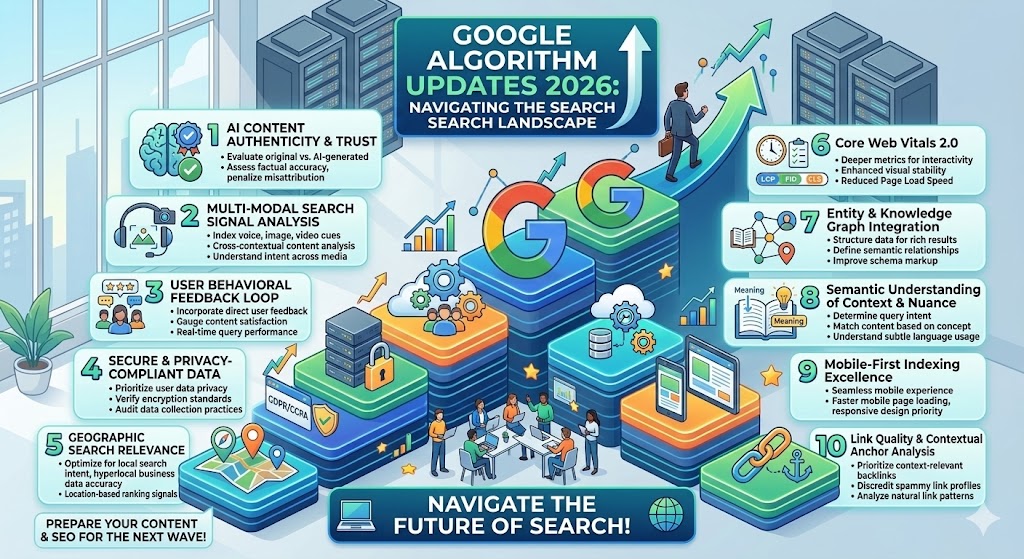
Google Algorithm Updates 2026
Introduction
Have you ever noticed how a website that ranked #1 on Google suddenly disappears from the first page overnight? For many business owners and digital marketers, that moment feels like a heart attack. Traffic drops. Sales decline. Panic sets in.
Behind the scenes, there’s usually one reason: a Google algorithm update.
In 2026, Google’s algorithm is more advanced than ever. It doesn’t just look at keywords anymore. It evaluates content quality, user experience, trust signals, and even how helpful your page feels to real people. For students and beginners stepping into SEO or digital marketing, understanding these updates isn’t optional it’s essential.
In this guide, you’ll learn what Google algorithm updates really are, what changed in 2026, how they impact websites, and most importantly, what practical steps you should take to stay ahead. By the end, you won’t just understand updates you’ll understand how to build websites that survive them.
What Is a Google Algorithm Update Really?
Let’s simplify it.
Google’s algorithm is a complex system that decides which pages appear in search results and in what order. When you type something into Google, millions of pages could match your query. The algorithm filters, ranks, and displays what it believes is most useful.
An algorithm update is when Google changes how this system evaluates websites.
Some updates are minor tweaks. Others are major “core updates” that can significantly shift rankings across entire industries.
In 2026, updates focus heavily on:
-
Content quality and originality
-
User experience and engagement
-
Authority and trust signals
-
AI-generated content detection and evaluation
-
Search intent alignment
The goal? To reward genuinely helpful content and reduce manipulation.
How Google’s Algorithm Has Evolved
To understand 2026 updates, you need context.
Years ago, SEO was simple:
-
Add keywords.
-
Build backlinks.
-
Rank higher.
That era is gone.
Over time, Google introduced major updates like Panda (content quality), Penguin (link spam), and Helpful Content updates. In 2026, the system is far more sophisticated. It uses advanced machine learning models to evaluate:
-
Whether content demonstrates expertise
-
If users stay on the page or bounce quickly
-
Whether information is updated and accurate
-
How trustworthy the website appears overall
Google now asks a deeper question:
“Does this page genuinely help the user?”
If the answer is no, rankings suffer.
Major Google Algorithm Update Trends in 2026
1. AI Content Quality Filtering
AI-generated content is everywhere in 2026. But Google has become better at identifying low-quality, mass-produced content.
What Google targets:
-
Thin articles with no depth
-
Rewritten content offering no new value
-
Pages created purely to rank
What Google rewards:
-
Unique insights
-
Real-world examples
-
Clear expertise
-
Human-centered writing
The message is clear: AI assistance is fine low-value content is not.
2. Experience Signals (Beyond E-E-A-T)
Google emphasizes Experience, Expertise, Authoritativeness, and Trustworthiness (E-E-A-T). But in 2026, “experience” carries more weight.
For example:
-
Product reviews from people who actually used the product rank higher.
-
Travel blogs with original photos outperform generic summaries.
-
Case studies beat theoretical advice.
Google wants proof that content creators know what they’re talking about.
3. User Engagement Metrics Matter More
Although Google doesn’t publicly confirm every ranking signal, 2026 trends strongly suggest that behavioral data plays a role.
Signals include:
-
Time spent on page
-
Scroll depth
-
Return visits
-
Click-through rate
If users click your page and quickly return to search results, that’s a negative signal.
4. Topical Authority Over Random Blogging
Publishing 200 random articles no longer works.
Instead, Google rewards topical depth.
For example:
A website focused only on digital marketing covering SEO, content marketing, PPC, analytics, and case studies builds authority faster than a site covering random topics like health, travel, and tech.
Consistency builds credibility.
Core Types of Algorithm Updates You Should Know
Core Updates
These broad updates happen several times a year. They reassess content quality across industries.
Impact:
-
Rankings may fluctuate widely.
-
No specific penalty just re-evaluation.
Best response:
-
Improve content quality.
-
Strengthen expertise signals.
-
Update outdated pages.
Spam Updates
These target manipulative tactics such as:
-
Link schemes
-
Cloaking
-
Keyword stuffing
-
Automated low-value content
Google’s spam detection is far more advanced in 2026.
Helpful Content Updates
These specifically reward content written for people not just search engines.
Pages written only to rank (without solving real problems) often decline after these updates.
How Algorithm Updates Affect Students and Beginners
If you’re just starting in SEO or digital marketing, algorithm updates might feel intimidating. But they’re actually an opportunity.
Why?
Because updates remove shortcuts.
That levels the playing field. You don’t need huge budgets or shady tactics. You need:
-
Good research
-
Clear writing
-
Strong structure
-
Real value
Beginners who learn ethical SEO from the start adapt faster than marketers who relied on outdated tricks.
Practical SEO Actions to Stay Safe in 2026
Let’s move from theory to action.
1. Focus on Search Intent
Every keyword has intent:
-
Informational
-
Transactional
-
Navigational
-
Commercial investigation
Before writing, ask:
What does the user actually want?
If someone searches “best laptops for students 2026,” they want comparisons not a 2,000-word history of laptops.
2. Improve Content Depth
Instead of writing 800-word surface-level articles, create comprehensive resources.
Include:
-
Real examples
-
FAQs
-
Updated statistics
-
Clear subheadings
Depth signals authority.
3. Update Old Content
Google favors freshness especially for fast-changing topics.
Review content every 6–12 months:
-
Update statistics
-
Improve formatting
-
Add new insights
-
Fix broken links
4. Strengthen Internal Linking
Internal links help Google understand site structure.
For example:
An article about “SEO Basics” should link to:
-
Keyword research guides
-
Technical SEO explanations
-
Content marketing strategy posts
This builds topical authority.
5. Optimize for User Experience
In 2026, technical SEO and UX go hand in hand.
Key areas:
-
Fast loading speed
-
Mobile responsiveness
-
Clean layout
-
Easy navigation
A slow, cluttered site will struggle even with good content.
Common Myths About Google Algorithm Updates
Myth 1: Google Targets Small Websites
False. Google doesn’t target size it evaluates quality.
Many small niche blogs rank higher than large corporate websites because they provide focused value.
Myth 2: Every Ranking Drop Means a Penalty
Not necessarily.
Core updates re-evaluate content. You may drop because competitors improved — not because you were penalized.
Myth 3: More Backlinks Always Mean Higher Rankings
Quality matters more than quantity.
Ten relevant, authoritative backlinks outperform 1,000 spammy ones.
Myth 4: Keywords Don’t Matter Anymore
They still matter but context matters more.
Google understands topics semantically. You don’t need to repeat a phrase 20 times. Natural language works better.
Real-World Example: Surviving a 2026 Core Update
Imagine a blog that publishes 500-word articles targeting trending keywords quickly.
After a core update:
-
Traffic drops by 40%.
-
Rankings decline.
Why?
Competitors publish:
-
2,000-word comprehensive guides
-
Real examples
-
Updated statistics
-
Clear formatting
-
Expert insights
Google shifts rankings to pages that better satisfy user intent.
The solution isn’t panic it’s improvement.
Rewrite thin content.
Add depth.
Demonstrate expertise.
Focus on value.
Over time, rankings recover.
SEO Career Opportunities in 2026
As algorithms become more advanced, demand for skilled SEO professionals increases.
Career paths include:
-
SEO Specialist
-
Technical SEO Analyst
-
Content Strategist
-
SEO Consultant
-
Digital Marketing Manager
Companies need people who understand:
-
Search intent
-
Content strategy
-
Analytics
-
Technical website structure
For students, this is good news.
SEO is not disappearing it’s evolving.
Skills Students Should Start Learning Today
If you’re serious about building a career in SEO, focus on:
-
Keyword research fundamentals
-
Search intent analysis
-
Content writing and editing
-
Basic HTML knowledge
-
Google Search Console interpretation
-
Website speed optimization
-
Data analysis basics
Learn how to think like both:
-
A search engine
-
A real user
That mindset wins long-term.
FAQs: Google Algorithm Updates 2026
How often does Google update its algorithm?
Google makes minor updates daily. Major core updates typically occur several times per year.
Can a website recover after an algorithm update?
Yes. By improving content quality, user experience, and authority signals, many websites recover in later updates.
Does AI-generated content hurt rankings?
Not automatically. Low-quality or unhelpful content hurts rankings — regardless of how it’s created.
How long does it take to see recovery after an update?
It can take weeks or months, often until the next core update reassesses your improvements.
Should beginners worry about every update?
No. Focus on building high-quality, user-first content. That strategy survives most algorithm changes.
Conclusion: Build for People, Not for Updates
Google algorithm updates in 2026 may sound complex, but the underlying principle is surprisingly simple:
Create content that genuinely helps people.
Every major update pushes the internet toward higher quality, deeper expertise, and better user experiences. Shortcuts fade. Manipulation declines. Value wins.
For students and beginners, this is empowering. You don’t need tricks. You need understanding, consistency, and a commitment to learning.
SEO is no longer about gaming the system. It’s about mastering it ethically.
If you focus on real knowledge, user intent, and long-term strategy, you won’t fear the next update you’ll be ready for it.
And in a digital world where search drives visibility, that skill is more valuable than ever.
Tags :
No Tags

0 Comments