



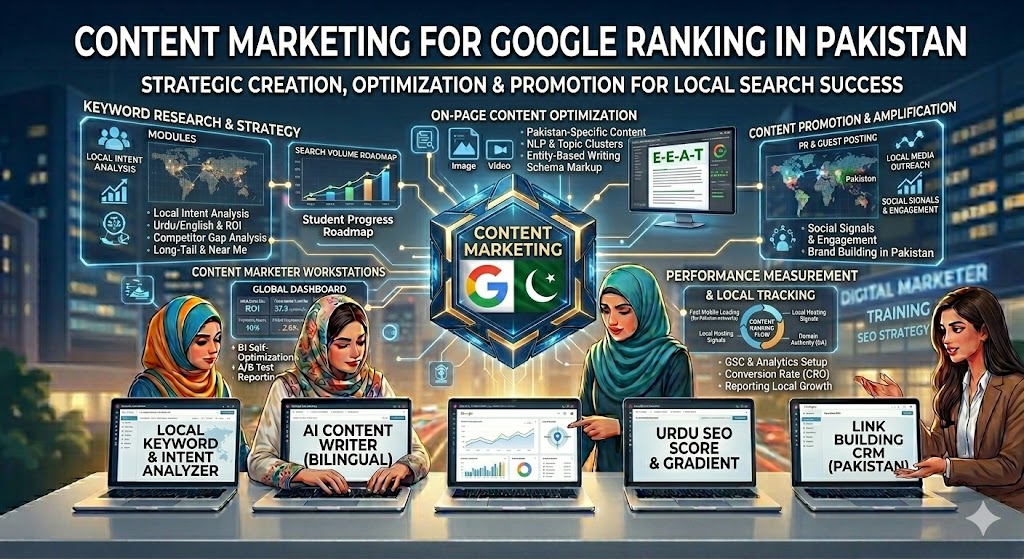
Content Marketing for Google Ranking in Pakistan
Introduction
Imagine you’ve built a website for your university project, a small business, or even a personal blog. You publish a few articles, share them with friends, and then… nothing happens. No visitors. No visibility. No results.
This is the reality many beginners face. Creating content is easy. Getting it ranked on Google is not.
In Pakistan, where thousands of students are entering freelancing, blogging, and digital marketing every year, understanding content marketing for Google ranking is becoming a powerful career skill. Businesses—from local startups in Lahore to e-commerce brands in Karachi depend on Google traffic. And Google traffic depends on smart, strategic content.
In this article, you’ll learn how content marketing helps websites rank on Google, how search engines evaluate your content, and what practical steps students can start taking today. We’ll break down complex ideas into simple, real-world explanations so you can confidently build skills that actually matter in the job market.
What Content Marketing Really Means for Google Ranking
When people hear “content marketing,” they often think it just means writing blog posts. That’s only part of the story.
Content marketing is the strategic creation and distribution of valuable content to attract, engage, and convert a specific audience. In the context of Google ranking, it means creating content that:
-
Solves real problems
-
Matches what users are searching for
-
Demonstrates expertise and credibility
-
Earns trust over time
Google’s goal is simple: deliver the most relevant and helpful results to users. If your content genuinely helps people, answers their questions, and keeps them engaged, Google notices.
In Pakistan’s growing digital economy, content marketing is no longer optional. It’s the foundation of:
-
Blogging businesses
-
E-commerce SEO
-
Affiliate marketing
-
Freelancing services
-
Corporate brand visibility
If you understand how to create content that ranks, you become valuable in almost any industry.
How Google Actually Works (In Simple Terms)
Before we talk strategy, let’s simplify how Google functions.
Google works in three main stages:
1. Crawling
Google uses automated programs called “bots” to scan websites. These bots discover new pages by following links.
If your content isn’t properly linked or indexed, Google may not even know it exists.
2. Indexing
After crawling, Google stores and organizes content in its massive database. It tries to understand:
-
What the page is about
-
Which keywords it relates to
-
Whether it’s high quality
If your content is thin, copied, or unclear, it may not be indexed properly.
3. Ranking
When someone searches “best SEO course in Pakistan,” Google quickly evaluates thousands of pages and ranks them based on:
-
Relevance
-
Quality
-
Authority
-
User experience
This is where content marketing becomes critical. Ranking is not about tricks—it’s about relevance and value.
Why Content Marketing Matters in Pakistan’s SEO Landscape
Pakistan’s online market is expanding rapidly. More businesses are going digital. More students are learning freelancing. More consumers are searching online before making decisions.
This creates two realities:
-
Competition is increasing.
-
High-quality content stands out more than ever.
A local clothing brand in Faisalabad, for example, can rank nationally if it produces useful style guides, fabric care tips, and seasonal fashion blogs optimized for search intent.
Content marketing allows smaller players to compete with bigger brands—without spending millions on ads.
Understanding Search Intent: The Core of Ranking
Many beginners focus only on keywords. Professionals focus on search intent.
Search intent means understanding why someone is searching.
There are four main types:
-
Informational – “What is SEO?”
-
Navigational – “Daraz official website”
-
Commercial – “Best laptop for students in Pakistan”
-
Transactional – “Buy iPhone 14 in Lahore”
If your content doesn’t match the intent behind the search, it won’t rank well—even if you use the right keywords.
For students, learning to identify search intent is one of the most valuable SEO skills.
Core Elements of Content Marketing for Google Ranking
1. Keyword Research (Without Overthinking It)
Keyword research isn’t about stuffing phrases everywhere. It’s about understanding how people search.
Good content marketers look for:
-
Questions people ask
-
Problems they want solved
-
Comparisons they search for
-
Local search trends in Pakistan
Instead of targeting “SEO,” a beginner might target:
-
“SEO course for beginners in Pakistan”
-
“How to start SEO freelancing in Pakistan”
-
“SEO roadmap for students”
These are specific, achievable, and relevant.
2. Creating High-Quality, Helpful Content
Google increasingly prioritizes helpful, people-first content.
High-quality content should:
-
Be clear and well-structured
-
Use simple explanations
-
Include real examples
-
Avoid fluff
-
Provide actionable advice
For example, instead of saying “SEO is important for digital growth,” explain how a small tutoring center in Islamabad doubled its student inquiries through blog articles targeting “O Level preparation tips.”
Specific examples build trust.
3. On-Page Optimization
On-page SEO ensures your content is structured properly.
Key elements include:
-
Clear H1 and H2 headings
-
Natural keyword placement
-
Optimized title and meta description
-
Internal linking to related articles
-
Short paragraphs and readable formatting
Students often underestimate formatting. But readability directly impacts engagement—and engagement influences ranking.
4. Content Depth and Authority
Google rewards comprehensive content.
A 300-word blog post rarely outranks a well-researched 1,500-word guide that:
-
Covers multiple angles
-
Answers related questions
-
Anticipates user concerns
Depth signals expertise.
If you’re writing about freelancing in Pakistan, don’t just define freelancing. Cover:
-
Platforms
-
Skills needed
-
Income potential
-
Common mistakes
-
Local payment methods
This makes your content authoritative.
5. Backlinks and Off-Page Signals
Backlinks are links from other websites to yours. They act as votes of confidence.
If reputable blogs, news sites, or educational platforms link to your content, Google sees it as trustworthy.
In Pakistan, backlinks often come from:
-
Guest blogging
-
Local business directories
-
Educational institutions
-
Industry collaborations
But remember: quality matters more than quantity.
6. User Experience and Technical Health
Even the best content struggles if the website is slow or poorly structured.
Google evaluates:
-
Page speed
-
Mobile responsiveness
-
Secure connection (HTTPS)
-
Clear navigation
Since most Pakistani users access the internet via mobile devices, mobile optimization is essential.
Real-World Example: A Pakistani Student Blog Success Story
Let’s say a university student starts a blog about freelancing tips.
Instead of randomly writing posts, she:
-
Researches beginner questions
-
Writes in-depth guides
-
Uses clear headings
-
Links related articles together
-
Shares posts on LinkedIn and Facebook groups
Over time:
-
Her traffic increases
-
She ranks for long-tail keywords
-
She gets freelance inquiries
-
She builds personal brand authority
This is how content marketing creates opportunities beyond traffic.
Common Myths About Content Marketing and Google Ranking
Myth 1: More Keywords = Higher Ranking
Overusing keywords actually harms readability and trust. Natural writing performs better.
Myth 2: SEO Works Overnight
SEO is a long-term strategy. Ranking can take weeks or months, especially for new websites.
Myth 3: Only Big Companies Can Rank
Small websites can rank if they target specific niches and provide real value.
Myth 4: Content Alone Is Enough
Content must be supported by technical health and link-building efforts.
Practical Skills Students Should Start Learning Today
If you’re serious about mastering content marketing for Google ranking, focus on:
-
Writing clearly and persuasively
-
Understanding search intent
-
Basic keyword research
-
WordPress fundamentals
-
Internal linking strategy
-
Content updating and optimization
Start a personal blog. Practice ranking for small keywords. Learn from real data instead of just theory.
Experience is your biggest teacher.
How SEO and Content Careers Are Evolving in Pakistan
The demand for SEO professionals in Pakistan is growing rapidly.
Opportunities include:
-
Freelancing on platforms like Upwork and Fiverr
-
Working with local agencies
-
Joining startups
-
Managing corporate websites
-
Building niche affiliate sites
Companies are no longer looking for people who “know keywords.” They want strategic thinkers who understand content, audience psychology, and business goals.
Students who combine writing skills with SEO strategy have a serious competitive advantage.
FAQs: Content Marketing & Google Ranking
1. How long does it take for content to rank on Google?
For new websites, it can take 3–6 months. Established sites may rank faster, depending on competition and content quality.
2. Is content marketing expensive for students?
No. You can start with a low-cost hosting plan and WordPress. The main investment is time and effort.
3. Do I need technical coding skills for SEO?
Basic understanding helps, but you don’t need advanced coding knowledge to start ranking content.
4. Can I rank without backlinks?
Yes, especially for low-competition keywords. However, backlinks significantly improve authority and ranking potential.
5. Is SEO a good career in Pakistan?
Absolutely. With global freelancing opportunities and local digital growth, SEO remains one of the most in-demand digital skills.
Conclusion
Content marketing for Google ranking is not about tricks, shortcuts, or chasing algorithms. It’s about understanding people what they search for, what problems they face, and how you can genuinely help them.
For students in Pakistan, this skill is more than academic knowledge. It’s a gateway to freelancing income, digital entrepreneurship, and long-term career growth. Businesses need visibility. Google rewards helpful content. And those who learn how to connect the two will always be in demand.
Start small. Publish consistently. Improve gradually. Think like a strategist, not just a writer.
If you commit to learning content marketing seriously, you’re not just learning SEO you’re building a digital asset that can shape your future.
Tags :
No Tags

0 Comments